
Your legacy reaches further than you can see
Most people's care reaches about seven generations. An old principle knew it. New research measured it.
Your legacy reaches further than you can see
Most people's care reaches about seven generations. An old principle knew it. New research measured it.
When most of us hear the word legacy, we think of the famous ones. Dolly Parton's Imagination Library, which has mailed more than three hundred million books to children in honor of a father who could not read (Imagination Library, 2026). The athlete whose record stands for forty years. The musician whose songs are still played at weddings three generations on. The founder whose company outlives them. These are legacies you can see, and they are real.
Then we look at our own, and we tend to see the parts that are near: the children, the company, the next decade, the names on the first page of the will. What is harder to see is how far a life actually reaches. Centuries ago, an Indigenous confederacy in North America built a principle around that distance, and recent research has, almost by accident, confirmed it.
The 175-year question
The Haudenosaunee, the confederacy of six nations centered in what is now New York and Ontario, have carried a principle for hundreds of years, rooted in their Great Law: that every important decision should be weighed by its effect on the seventh generation to come (Joseph, 2020). A generation is roughly twenty-five years. Seven of them is about a hundred and seventy-five. So the principle asks a leader, and it applies to a household as much as to a council, to picture the people who will be alive a hundred and seventy-five years from now, and to make the decision with them in mind. It also looks back. A leader asks what the seven generations before would have made of the choice, so that a decision answers to the people who came before as well as to the people who will come after (Rousseau-Thomas, 2023).
The principle is sometimes borrowed as a slogan; held properly, it is a discipline. Before you decide, you ask who will be living with the result that far ahead, and you let that answer shape what you do.
Four more ways to put the future in the room
The Haudenosaunee named the distance most clearly, and they are not the only people who have built a practice around it.
In Japan, the Grand Shrine at Ise has been taken down and rebuilt on the neighboring plot every twenty years for about thirteen hundred years. The buildings are not the point. The point is that the people who build it take part more than once in a life, learning the first time and teaching the next, so that the skills pass from hand to hand and never have to be recovered from a book (Nuwer, 2013).
In 2015, Wales passed a law that requires every public body in the country to weigh the long-term effect of its decisions on people not yet born, and appointed a Future Generations Commissioner to hold them to it (Future Generations Commissioner for Wales, n.d.). Japanese researchers have gone further and put the future in the room. In the town of Yahaba, residents were asked to deliberate on housing and public facilities twice: once as themselves, and once as citizens of 2050, wearing a traditional happi coat as a reminder of whom they were speaking for. As themselves, they talked about safety and function. As the future, they talked about the quality of the town's life and whether it would last (Hara et al., 2019).
And in a mountain in West Texas, a foundation is building a clock designed to keep time for ten thousand years, for no practical reason except to make a long future feel real to the people who visit it (The Long Now Foundation, n.d.).
Different peoples, different centuries, and each of them arrived at the same practice: before the decision, bring the people who are not yet born into the room, because left to ourselves we forget them. Notice, too, what each of these has become. A principle held for hundreds of years. A rebuilding kept up for thirteen hundred. They are not only ways of thinking about legacy. They are legacies, still carried by people who never met the ones who began them. Which raises a fair question: how far does a person's care reach on its own?
Where human care stops, and what moves it
In 2025, a team at Boston College set out to measure how far into the future people's care naturally reaches. Across five studies and nearly four thousand people, they asked how many future generations a person should consider, and then had people map which generations they felt responsible for (Law et al., 2025).
Asked directly, most people said about nine generations. But when they drew the circle, most of them placed the line almost exactly where the Haudenosaunee placed it. For roughly four in five people, concern extended through about the seventh generation and then fell to nearly nothing. A smaller group, about one in five, placed every generation they were shown inside their circle, all fifty of them.
Then the researchers tried something. They had people spend a few minutes with a simple thought: that it does not matter when a harm happens, only that it happens, and that the people of the future are as real as the people of today. After that short reflection, the horizon of care moved from about two hundred and fifty years out to about a thousand.
The samples were American adults recruited online, and that limits what the findings can claim. But two things hold. The seventh generation is close to the natural edge of human care, which means the old principle was never asking people to do something unnatural. It was naming where our care already reaches, and asking us to plan for it on purpose. And the edge can move, with a few minutes of attention.
Two reasons to leave a legacy. Only one arrives.
There is a second finding worth knowing, because it bears on why a person thinks about the future at all.
Researchers studying what moves people to act for future generations separated two motives that usually travel together. One is the wish to be remembered: to have a name that lasts. The other is the wish to have mattered: to leave the people who come after better off, whether or not they know who did it. When each motive was tested on its own, in a single study in one country, the wish to matter moved people to give to the future. The wish to be remembered did not (Zha et al., 2026). An earlier study found the same direction: people who wrote a few sentences about what they wanted future generations to remember them for gave nearly half again as much to a cause meant for those generations, and the share who gave at all rose from six in ten to seven in ten (Zaval et al., 2015).
This is the difference we describe in Legacy Was Never About the End. A legacy built against being forgotten reaches for a monument. A legacy built to matter to the people who come after reaches those people. The research suggests the second kind is the one that still reaches someone seven generations on.
Ten people, seven generations, ten million
Most people underestimate their reach for a simple reason: they count only the people they can see.
Researchers who tracked how behavior spreads found that generous behavior travels up to three degrees of separation: from one person to the people they influence, to the people those people influence, and on to a third circle the first person never meets (Fowler & Christakis, 2010). The same held for cooperation, and the same holds, in everyday experience, for how people are treated. The way you treated the people who worked for you became the way they treat the people who work for them.
Now put that beside time. Suppose, over a life, you shape ten people deeply: the ones you hired early, mentored, raised, or stood beside. Suppose each of them, in turn, shapes ten. By the third generation that is a thousand people. By the seventh, it is ten million, which is more than the population of most countries, and almost none of them will know your name. Make it three people instead of ten, and the seventh generation still holds more than two thousand. The numbers are an illustration. Nobody can count this, and it was never meant to be counted. But the direction is not in doubt. A life does not end at its line of sight. It compounds through people. And it compounds whether you plan for it or not. The only question is what it carries.
The bigger legacy is not the bigger number
There are two ways to measure a legacy. One counts what you leave: the dollars, the buildings, the name on the door. By that ruler, a legacy is exactly as big as the estate. The other counts who carries it, and for how long. By that ruler, a company at its height is a few thousand people for a few decades. A foundation is more people, for longer. A seventh generation is millions of people across a hundred and seventy-five years, and it runs on nothing but what one person handed to the next.
If you want a legacy that scales, and most people who have built something do, the second ruler is the one that measures it. The biggest legacy is not the one with the largest number attached to it. It is the one still being carried by people who never heard your name, because what you entrusted forward was true enough to keep. So what, exactly, travels that far?
What still arrives seven generations on
Robin Wall Kimmerer, a botanist and a member of the Citizen Potawatomi Nation, writes about the oldest form of this: the gift. In the traditions she describes, what you receive from the world is understood as given, and the proper response to a gift is to use it well and to give in return, so the exchange continues past you (Kimmerer, 2013). That is the Roman root of the word legacy, seen from a different continent: something placed in another's hands and sent forward.
What actually reaches a seventh generation is rarely the thing people assume. Few companies last a century in any form. The building may, with a different name on it. The instruments your advisors use are the ones built for this distance, the trust that can run for generations, the letter beside it that says why, the foundation with a mission, and they carry best what was chosen on purpose. Beyond them, what travels is smaller and more durable than any of it. A pattern that ended with you, so that it was never passed down. The family story that was written down instead of lost. A piece of land that was brought back and is still alive. A habit of honesty that gave everyone near it permission to live the same way, and that they handed on without knowing where it came from.
That is why we hold that a legacy is not measured by its size. A quietly redesigned life reaches as far as a foundation with a name on it, and sometimes further, because what it sends forward is carried by people rather than kept in a building. What makes a legacy real is its truth. What makes it reach is how it was lived.
Designing for a reach this long
This is the scale we design for, and it is the most hopeful part of the work. The way we do it is called the Lived Legacy Approach™. It has two steps, taken in order.
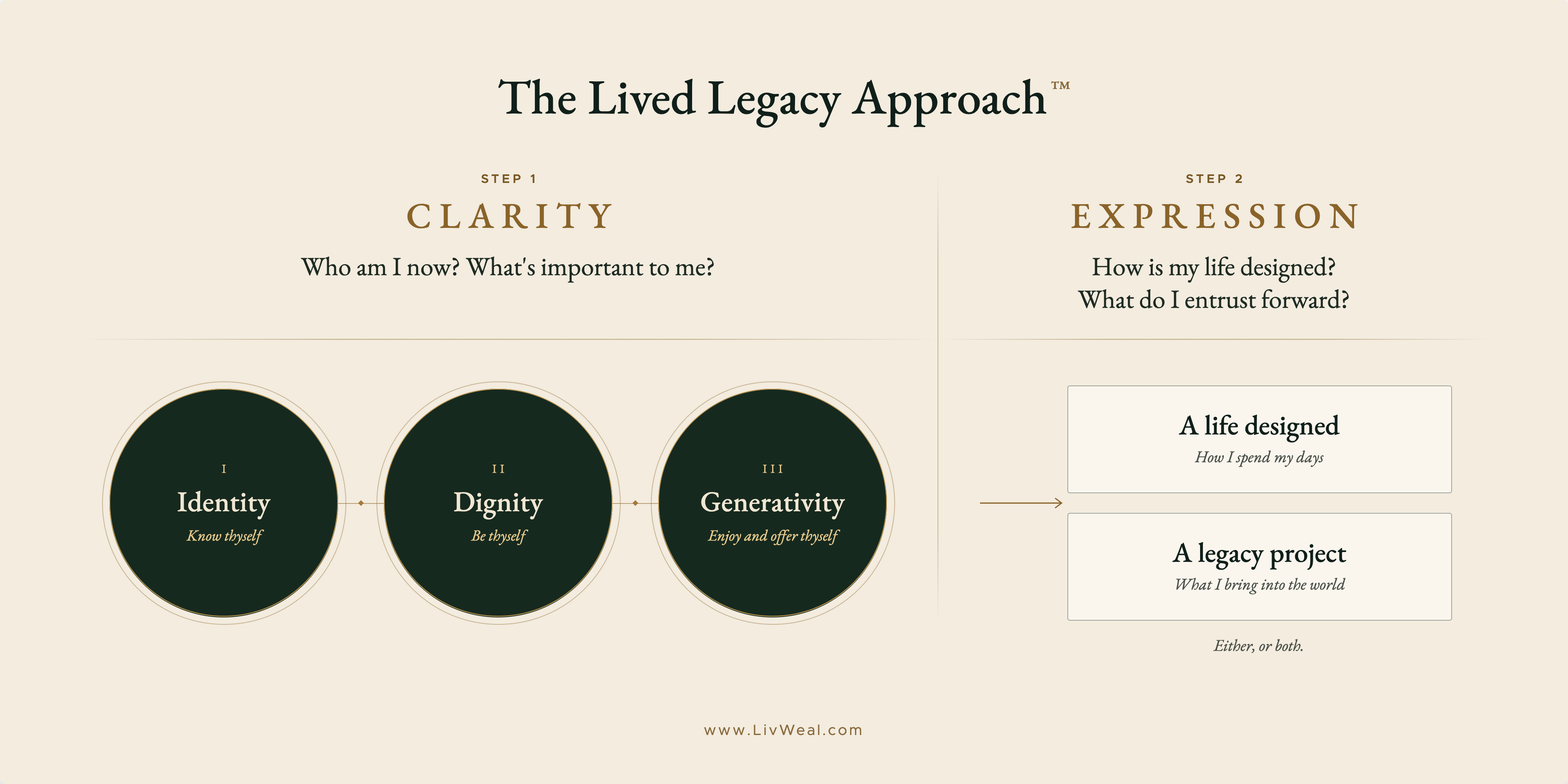
The first step is clarity, and it has three parts. Identity: know thyself, who you are now, apart from the role you held. Dignity: be thyself, how you honor your own worth and the worth of others in how you actually live. Generativity: enjoy and offer thyself, what is yours to receive from this life and what is yours to give. The order matters, because what you have to give only becomes clear once you know who you are and how you want to live.
The second step is expression: the shape that clarity takes. For some it is a life designed on purpose, how you spend your days and who you spend them with. For others it is a legacy project, something built that lasts. For many it is both.
A legacy designed this way is two things at once. It is deeply satisfying to the person living it, because it comes from who they are rather than from what would look right. And it is of service to people beyond them, some of whom they will never meet. We believe that is what a full legacy is: a life that is enjoyed and offered at the same time. When who you are and how you honor your worth shape what you give, the impact reaches far past your own years, and the world the seventh generation inherits is a little more beautiful for it.
Running through both steps is one question drawn from the Haudenosaunee principle, which we ask people to hold as they decide what's next. Of the things you are choosing now, which will someone be living with in a hundred and seventy-five years, and is that the one you would choose?
That is the scale of a legacy. It was always this large. Whether you plan for it is the choice.
Legacy is how the way we live becomes part of the world others inherit.
Live Your Legacy.
If you would like to talk about yours, we would be glad to.
Request a conversation.
References
Fowler, J. H., & Christakis, N. A. (2010). Cooperative behavior cascades in human social networks. Proceedings of the National Academy of Sciences, 107(12), 5334–5338. https://doi.org/10.1073/pnas.0913149107
Future Generations Commissioner for Wales. (n.d.). The Well-being of Future Generations (Wales) Act 2015. https://www.futuregenerations.wales/about-us/future-generations-act/
Hara, K., Kitakaji, Y., Sugino, H., Yoshioka, R., Takeda, H., Hizen, Y., & Saijo, T. (2019). Effects of experiencing the role of imaginary future generations in decision-making: A case study of participatory deliberation in a Japanese town (RIETI Discussion Paper 19-E-104). Research Institute of Economy, Trade and Industry. https://www.rieti.go.jp/jp/publications/dp/19e104.pdf
Imagination Library. (2026). Year in review. Dollywood Foundation. https://imaginationlibrary.com/news-resources/year-in-review/
Joseph, B. (2020, May 30). What is the Seventh Generation Principle? Indigenous Corporate Training Inc. https://www.ictinc.ca/blog/seventh-generation-principle
Kimmerer, R. W. (2013). Braiding sweetgrass: Indigenous wisdom, scientific knowledge, and the teachings of plants. Milkweed Editions.
Law, K. F., Syropoulos, S., Young, L., & O'Connor, B. B. (2025). Mapping prescriptive beliefs on seventh generation stewardship and increasing the temporal scope of intergenerational concern. Scientific Reports, 15, Article 37618. https://doi.org/10.1038/s41598-025-21466-9
The Long Now Foundation. (n.d.). The 10,000 Year Clock. https://longnow.org/clock/
Nuwer, R. (2013, October 4). This Japanese shrine has been torn down and rebuilt every 20 years for the past millennium. Smithsonian Magazine. https://www.smithsonianmag.com/smart-news/this-japanese-shrine-has-been-torn-down-and-rebuilt-every-20-years-for-the-past-millennium-575558/
Rousseau-Thomas, J. (2023, June 5). Thinking differently: Using the Seven Generations Principle. Generation Squeeze. https://www.gensqueeze.ca/thinking_differently_using_the_seven_generations_principle
Zaval, L., Markowitz, E. M., & Weber, E. U. (2015). How will I be remembered? Conserving the environment for the sake of one's legacy. Psychological Science, 26(2), 231–236. https://doi.org/10.1177/0956797614561266
Zha, S., Li, X., & Zhang, Y. (2026). The influence of psychological ownership of nature and legacy motivation on pro-environmental decision-making in the intergenerational dilemma. Behavioral Sciences, 16(5), Article 786. https://doi.org/10.3390/bs16050786