

Where they stood

Every year, billions of plastic cups are used for a few minutes and then kept by the earth for centuries. Chelsea “Sea” Briganti and Leigh Ann Tucker, industrial designers trained at Parsons School of Design, set out to make the opposite: something that does its work beautifully, then disappears.
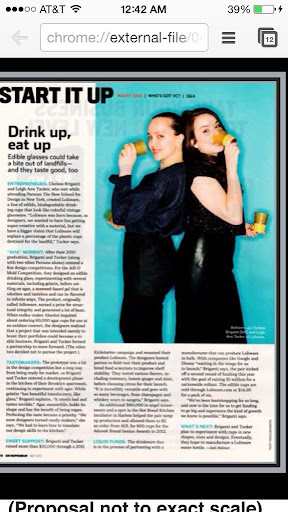
In 2014, their answer was a cup made from seaweed. You could drink from it, then eat it. Whatever you left behind went back to the earth. The cup won a Jell-O mold competition. Oprah’s magazine wrote about it. Then the phone began to ring, and big buyers wanted to place orders.
It was the moment every maker hopes for, and it came before they were ready. They had a material and a mission. They did not yet have a way to turn that material into things the world could use at scale: cups first, then straws, then packaging itself. They did not know how to pay for it. And there was no company yet strong enough to carry a vision this big.
“We won a Jell-O mold competition, and then Diageo and Oprah wanted to start placing orders. But we were a design studio. We had no idea how to start, or how to think about this project and our legacy of replacing plastic packaging in the world. Please help us.”
What they chose
They began with Legacy in Motion, our work with people bringing a legacy project to life.
Jennifer stepped in during the spring of 2014 as their central startup advisor, and in time became their partner. The work was to take a beautiful idea and give it a body: something that could be built, funded, and carried into the world.
Piece by piece, it took shape. A business plan that showed investors what the designers already knew. A strategy for raising money, and the introductions to raise it. A founding team around the two of them. Their first manufacturing and production facility. A first purchase order for $100,000, signed before a single cup came off the line. Press that put an edible cup in front of the country.

In October 2015, Sea and Leigh Ann walked onto ABC’s Shark Tank and walked out with a deal from Mark Cuban: $600,000 for 25 percent of the company. The night the episode aired, about $130,000 in orders came in.


Seventeen months. From a whiteboard propped against a wall to money in the bank, product on the move, and a company that could stand on its own.
As seen in


What stands now

The cup was only the beginning. Loliware is now a materials company. Its patented, seaweed-based SEA Technology lets brands replace plastic in what they make and ship, using a plant that grows back fast and, as Loliware puts it, helps regenerate the ocean as it grows.
The company has raised more than $15 million, works with José Andrés Group, and was named one of TIME’s America’s Top GreenTech Companies of 2024. Sea leads it today as CEO.
A contest entry became a company working to take plastic out of the world’s packaging. Every Loliware product is designed to disappear. The legacy behind it is built to last.


In their words
“Imagine the ultimate guide, strategizing your business with you and making sure every piece is aligned so the only way to go is up. With Jennifer, the only possible outcome is success.”
Chelsea “Sea” Briganti, Co-founder and CEO, Loliware
Jennifer Love is a partner in Loliware.
If you or someone you know is standing where Sea and Leigh Ann stood, we would be glad to talk with them.
If someone you advise is standing here, we would be glad to talk with you first.